Apizr Academy
Start with an existing Python function and follow it through inspection, selection and your first REST or MCP call. Then follow a synthetic fraud example through experiment inspection, retained Runs, comparison, serving and Python tracking. These English-language lessons explain the results, their limits and the next decision. The written guides remain authoritative: a recording may show an earlier version of Apizr.
The covers below are local images. YouTube loads only when you select a play button; playback uses its privacy-enhanced player. Each lesson also links to written steps you can follow without watching a video.
Open the Academy playlist on YouTube.
Start here: from Python to a callable service
00 — See the result
Turn existing Python expertise into APIs and AI tools · Demonstration · 2:34
Result: see an existing route calculation used by an application and an AI assistant through REST and MCP.
Follow the written steps · Understand capabilities
01 — Install
Academy Part I — Install Apizr with pip, uv, pipx or Homebrew · 6:39
Result: install Apizr in your chosen environment and check its version.
02 — Inspect
Academy Part II — Inspect a project and understand readiness · 4:11
Result: identify a function's interface contract and read the reasons it is ready, conditional or refused, without running project code.
Follow the written steps · Understand Readiness
03 — REST
Academy Part III — Generate a REST API and make HTTP calls · 4:14
Result: generate a REST bundle and call a selected Python function over HTTP.
Follow the written steps · Choose what becomes public
04 — MCP
Academy Part IV — Generate MCP tools and call them with Python · 5:09
Result: generate an MCP bundle, discover its tools and call one with a Python client.
Follow the written steps · Understand REST and MCP
05 — OCI
Academy Part V — Build an OCI image and call its MCP tool with Ollama · 8:21
Result: build a service image from an existing bundle and call its MCP tool from the demonstrated Ollama client.
Follow the written steps · Choose the execution boundary
Understand the decisions
Read these short chapters in order, or open the one that answers your next question:
- What is a capability?
- What does Readiness decide?
- What does Exposure select?
- Where does execution happen?
- What do REST and MCP expose?
Experiment path — from evidence to serving
These advanced lessons use the same synthetic fraud example and a recorded Apizr 0.4.6 candidate. Start with the Data Scientist quickstart, then use each lesson's written guide to repeat the operations and check their current scope.
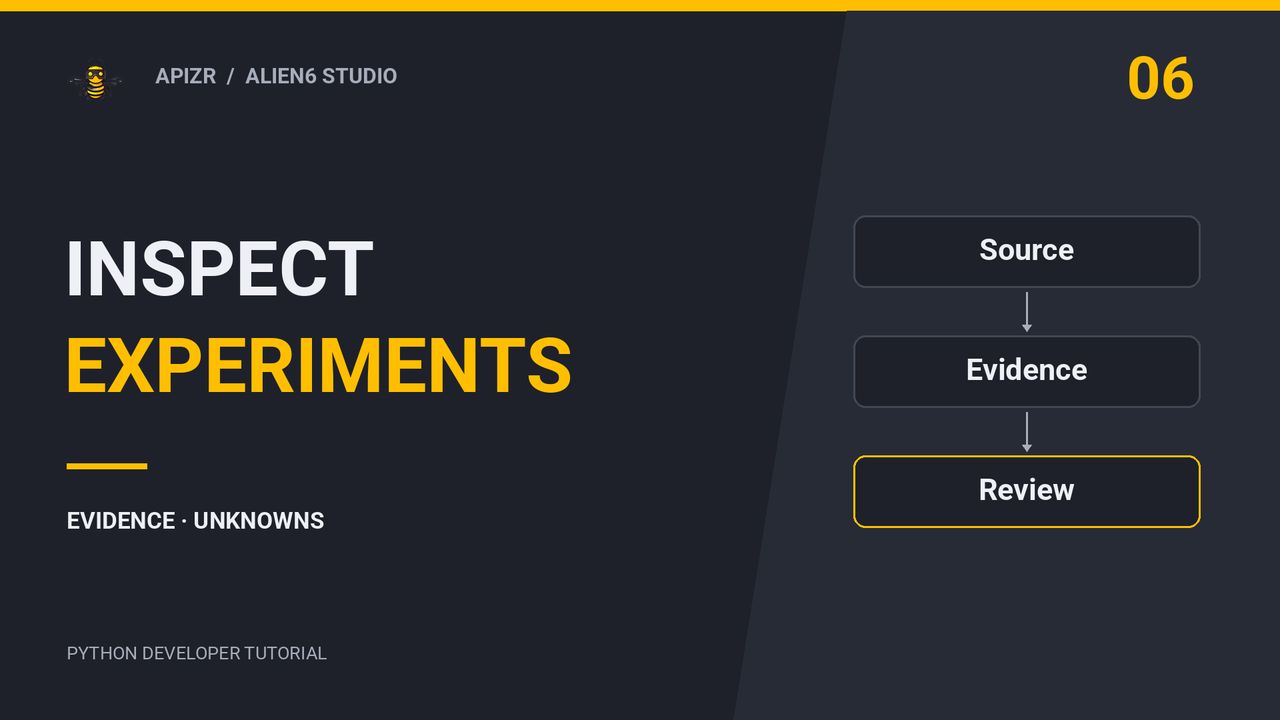
06 — Inspect experiment evidence
Academy Part VI — Inspect a machine learning notebook without running it · 5:54
Result: read inspection evidence, change the selected CSV and distinguish a recognized metric call from an observed result, before training the model.
07 — Run an experiment and read its history
Academy Part VII — From notebook to Run: experiments and local history · 6:15
Result: execute the reviewed notebook, read its retained evidence and distinguish an artifact fingerprint from preservation of the artifact's bytes.
08 — Compare experiment Runs
Academy Part VIII — Compare data, models and observed metrics · 7:15
Result: compare two actual Runs, interpret metric deltas in both directions and keep unknown evidence explicit. Changed synthetic label rules limit the conclusions that can be drawn about model quality.
09 — Expose a selected prediction
Academy Part IX — Bind a retained model to REST and MCP · 6:50
Result: select a Run, prediction capability, retained model and dependencies; inspect both local interface bundles and observe the refusal of changed model bytes. Deployment remains a separate step.
10 — Track Python calls
Academy Part X — Capture calls with sessions and decorators · 6:30
Result: evaluate classification thresholds on the same held-out sample, choose the unit of capture and retain selected inputs and observed metrics while preserving normal return values and exceptions.
11 — Capture real Jupyter cells
Academy Part XI — Track cell executions and hidden kernel state · 5:56
Result: read actual cell identities and execution counts from a live Jupyter kernel, repeat a cell and compare its retained evidence. The recording shows the real kernel through a terminal; selected file and parameter identities do not identify every in-memory value or setting.
12 — Review real experiment Runs in VS Code
Academy Part XII — Review real experiment Runs in VS Code · 6:22
Result: train decision trees on the public Wine dataset, browse their actual SDK and Jupyter Runs in the extension, inspect saved source and interpret the canonical comparison.